Stableford
ScoringStableford is a golf scoring format where you score points on each hole instead of adding up strokes: 2 points for a net par, 1 for a net bogey, 3 for a net birdie, 4 for a net eagle and 0 for a net double bogey or worse. The player with the most points wins, and 36 points over 18 holes means you played to your handicap.
The Stableford points table
Under Rule 21.1 of the Rules of Golf, points on each hole are awarded by comparing your score with a fixed score for the hole. In a handicap competition the fixed score is net par: par plus the handicap strokes you receive on that hole.
| Score on the hole | Points |
|---|---|
| More than one over the fixed score, or no score returned | 0 |
| One over (net bogey) | 1 |
| Fixed score (net par) | 2 |
| One under (net birdie) | 3 |
| Two under (net eagle) | 4 |
| Three under (net albatross) | 5 |
| Four under | 6 |
How handicap strokes turn into points
Start from your Course Handicap for the tees you play, then apply the competition’s handicap allowance to get your Playing Handicap. The World Handicap System recommends 95% for individual Stableford. The strokes are then given out by stroke index: one on each hole whose stroke index is at or below your Playing Handicap, and a second one on the hardest holes when it is above 18.
Points on a hole = 2 + par + strokes received − your gross score, and never less than 0. That one line is the whole of Stableford.
Worked example
A golfer with a Handicap Index of 18.4 plays tees with a Slope Rating of 130, a Course Rating of 71.8 and par 72. Their Course Handicap is 18.4 × (130 ÷ 113) + (71.8 − 72) = 20.97, so 21. With the 95% allowance, applied to the unrounded figure as the R&A recommends, the Playing Handicap is 20.97 × 0.95 = 19.92, so 20: one stroke on every hole and a second on stroke indexes 1 and 2. The first six holes go like this:
| Hole | Par | Stroke index | Strokes received | Gross score | Net score | Points |
|---|---|---|---|---|---|---|
| 1 | 4 | 7 | 1 | 5 | 4 (net par) | 2 |
| 2 | 5 | 1 | 2 | 8 | 6 (net bogey) | 1 |
| 3 | 3 | 17 | 1 | 3 | 2 (net birdie) | 3 |
| 4 | 4 | 2 | 2 | 9 | 7 | 0 |
| 5 | 4 | 11 | 1 | 4 | 3 (net birdie) | 3 |
| 6 | 5 | 5 | 1 | 6 | 5 (net par) | 2 |
Why golfers like it
- A disaster hole costs you at most the 2 points you would have scored for a net par, instead of wrecking the whole card as it would in stroke play. On hole 4 above, a 9 and a 12 both score 0.
- Once you can no longer score a point on a hole you can pick up and walk to the next tee, which keeps the pace of play moving. In the example, the golfer on hole 4 could pick up once they had played 8 strokes without holing out.
- It rewards good holes: a net birdie is worth one more point than a net par, so aggressive play on the holes where you get a stroke can pay off.
- Scores are easy to compare across a field. 36 points is playing to your handicap; above that is a good day.
Stableford and your Handicap Index
A Stableford round is still an acceptable score for handicap purposes. For posting, each hole is converted back into strokes and capped at net double bogey (par + 2 + strokes received, using your Course Handicap). A hole where you picked up because you could no longer score a point is recorded as net double bogey, the most any hole can count for anyway, so picking up does not hurt your handicap.
Scoring Stableford with Golfonaut
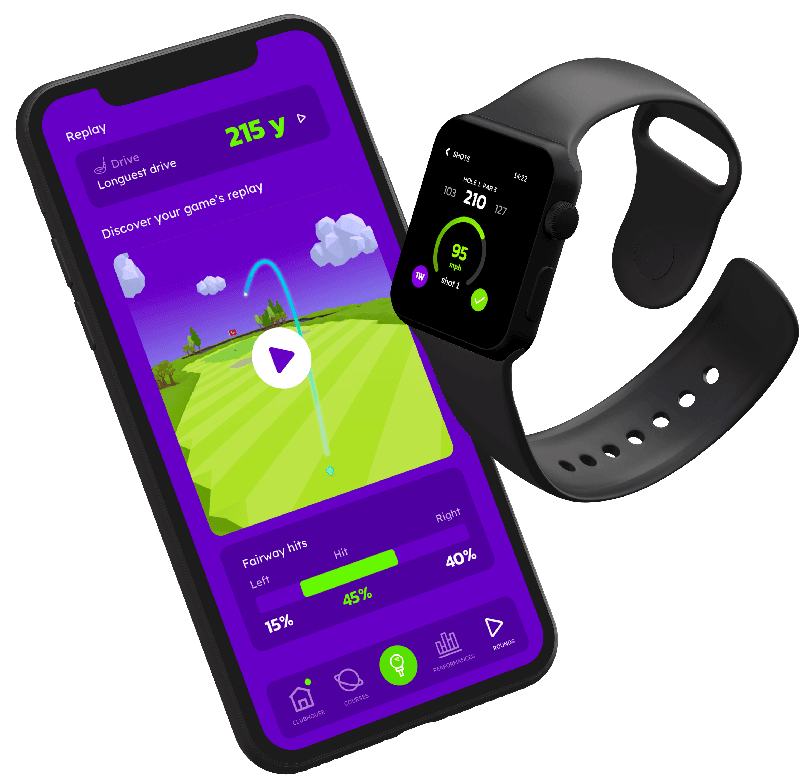
When you start a round in Golfonaut you choose stroke play or Stableford. In Stableford the scoring screen on your Apple Watch switches from strokes to points, and every hole you record uses the same formula as above: 2 + par − gross score for gross points, plus the strokes you receive for net points, never below 0.
Net points use the handicap you set on the new-round screen (it starts from the one in your profile) and the stroke index of each hole, so they need a course map that includes stroke indexes. The app uses that number as it is, without Slope Rating or an allowance, so for a competition-exact net total enter your Playing Handicap for the day. On a 9-hole course the handicap is halved before strokes are given out. Net scores are part of the optional Golfonaut Private Club subscription; gross Stableford points are free.
Related tools and guides
Sources
- The R&A, Rules of Golf, Rule 21: Other Forms of Individual Stroke Play and Match Play
- The R&A, Rules of Handicapping, Rule 6: Course Handicap and Playing Handicap
- The R&A, Interpretations on Rule 6
- The R&A, Rules of Handicapping, Appendix C: Handicap Allowances
- The R&A, Rules of Handicapping, Rule 3: Adjustment of Hole Scores
Last reviewed .
Related terms
Par
Each hole on a golf course has a designated score that is used to represent its difficulty. Pars range from 3 to 5 normally, although some courses have par 6 holes. The sum of the pars for all the holes totals the par for the course.
Bogey
A score of one over the par of the hole.
Course Handicap
The number of strokes a player receives on a specific course from a specific set of tees. Under the World Handicap System it is Handicap Index × (Slope Rating ÷ 113) + (Course Rating − Par), rounded to a whole number.