Estimate your golf Handicap Index from recent scores using the World Handicap System (WHS) method. Enter at least 3 scores; the more (up to 20), the closer the estimate.
By the Golfonaut team · Updated
Understanding Golf Handicaps
A golf handicap is a numerical measure of a golfer's potential scoring ability. It allows players of different skill levels to compete fairly against each other. The World Handicap System (WHS) provides a consistent method for calculating handicaps worldwide.
How It Works
Recent Scores:Up to your last 20 adjusted gross scores (each hole capped at net double bogey)
Calculation:Each score becomes a differential: (113 ÷ Slope) × (score − Course Rating). With 20 scores, the lowest 8 are averaged; with fewer, WHS uses fewer and adjusts
To calculate a Handicap Index under the World Handicap System, turn each round into a Score Differential with (113 ÷ Slope Rating) × (Adjusted Gross Score − Course Rating), then average the lowest differentials from your most recent 20 rounds: the lowest 8 of 20, or fewer, with a small adjustment, when you have played fewer than 20. That is the method in Rule 5 of the Rules of Handicapping, and it is what the calculator above does.
Cap each hole. Your Adjusted Gross Score counts no hole higher than net double bogey: par + 2 + any strokes you receive on that hole.
Find the Course Rating and Slope Rating for the tees you played. They are on the scorecard or your golf association's course database.
Work out the Score Differential for each round and round it to one decimal place.
Average the lowest ones using the table below, apply the adjustment, and round to one decimal. The result is capped at 54.0.
How many differentials WHS averages (Rule 5.2)
Rounds in your record
Lowest differentials used
Adjustment
3
1
−2.0
4
1
−1.0
5
1
none
6
2
−1.0
7 to 8
2
none
9 to 11
3
none
12 to 14
4
none
15 to 16
5
none
17 to 18
6
none
19
7
none
20
8
none
Worked example: six rounds
Say your six rounds are 92 (Course Rating 71.2, Slope 128), 88 (70.4, 125), 95 (72.1, 131), 90 (71.2, 128), 86 (69.8, 121) and 93 (70.4, 125). Their differentials are 18.4, 15.9, 19.8, 16.6, 15.1 and 20.4. With six rounds WHS uses the lowest two, 15.1 and 15.9, which average 15.5, and then takes off 1.0. The Handicap Index is 14.5. Enter the same six rounds above and the calculator returns the same number.
An official index also runs the playing conditions calculation and the soft and hard caps against your full record, so the number your association publishes can differ slightly. Turning the index into the strokes you get on a given course is covered in Course Handicap and Playing Handicap.
Your Course Handicap is your Handicap Index × (Slope Rating ÷ 113) + (Course Rating − Par), rounded to the nearest whole number. It is the number of strokes you get on the tees you are playing. For a competition, multiply it by the format's Handicap Allowance (95% for individual stroke play) to get your Playing Handicap. Enter your index and the tee's ratings below.
Plus handicap? Type it with a + sign, e.g. +1.2.
Your committee sets the allowance; these are the WHS recommendations.
Your strokes for this course
Fill in all four numbers to see your Course Handicap and Playing Handicap.
Worked example
With the Handicap Index of 14.5 from the example above, on tees rated 71.2 with a Slope of 128 and a par of 72: 14.5 × 128 ÷ 113 = 16.42, plus (71.2 − 72) = 15.62, so the Course Handicap is 16. In a stroke play competition at 95%, 15.62 × 0.95 = 14.84, a Playing Handicap of 15.
9-hole Course Handicap
For 9 holes, halve the Handicap Index first (rounded to one decimal) and use the 9-hole ratings and par: (Handicap Index ÷ 2) × (9-hole Slope Rating ÷ 113) + (9-hole Course Rating − 9-hole Par). Choose 9 holes above to use it.
This calculator applies the WHS averaging table, but it cannot apply the playing conditions calculation, the soft and hard caps or exceptional-score reductions, which need your full record. For an official Handicap Index you should:
Register with your local golf association
Submit scores through official channels
Play enough rounds to establish a reliable handicap
Keep accurate records of all your scores
Ready to Transform Your Golf Game?
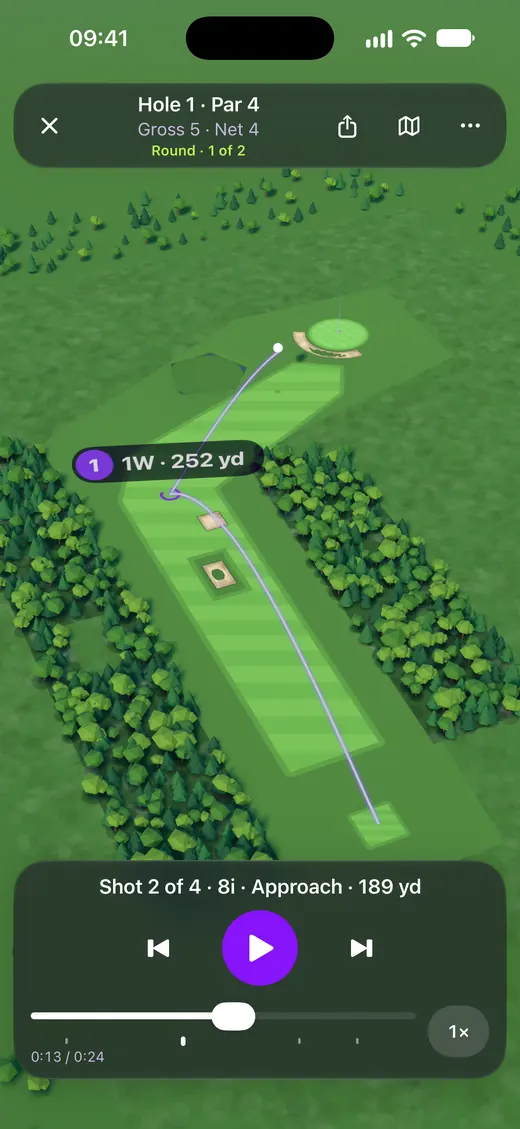
Download Golfonaut and use your Apple Watch for distances to the green, one-tap shot tracking and scorecards on the course.
Try GolfonautGolfonaut is on iPhone for now. Android is coming soon.
Scan with your iPhone camera Get Golfonaut on the App Store Requires iPhone and Apple Watch